How glyphs work
A glyph is a ring with a sigil in its middle and signs around it. The sigil is the element; the signs say what it does. Nothing happens until the ring is closed, so witches leave a small gap and close it when they need the spell.
On Glyphs, the first page of A Witch's Primer
The symbols themselves are on Sigils and signs; every known glyph is under Spells.
The rules
| Size | A bigger ring is a stronger spell. |
| Neatness | A neat hand makes a stronger glyph that wears more slowly. |
| Ink | Some inks are stronger, last longer or resist water. See Inks. |
| Wear | A glyph works for as long as it is whole. Rain washes ordinary ink away, feet scuff it, a rag rubs it out. |
| Orientation | A sign drawn the other way round does the opposite: Levitation presses down, Pull pushes, Crush mends. Columns turned inward lay the element flat along the surface instead of raising it. |
| Striking out | A straight line struck right through a sign switches it off, as if it were never drawn. A page that cannot be rubbed out can still be mended this way. |
| Counting | Some signs count: each Bolt is one fireball, each Bird is one bird. |
| Pictures | A picture sign calls up the thing it shows, made of the element: a Horse over Water is a horse of water. |
| Sign size | Signs drawn big beside their ring make the spell stronger, small ones weaker: up to about a third either way. |
| Lean | A sign drawn longer on one side pulls the spell that way. |
| Mixing | Two kinds of shaping in one ring work side by side, if each is drawn at least twice. A single stray sign does nothing. |
| Surface | A glyph on a wall throws its spell sideways. Earth magic needs a surface: from a page, look at the block. |
Regions

The Region sign, a little fork, does not move a spell: it says where the spell may happen. Draw it between the other signs.
| Regions | The spell happens |
|---|---|
| Opening outward | Outside the ring: the middle is kept clear |
| Opening inward | Inside the ring only |
| A pair facing each other | On the ring line |
| All opening one way | On that side |
Ring of Fire is Fire with four Dispersion signs and four outward Regions: the flames run in a ring around a safe centre.
Nested glyphs
A ring inside a ring shapes the spell within. Draw a whole glyph, ring it again, and put signs in the band between the two rings: Repetition keeps the glyph from wearing away, Enlarge makes it stronger, Billowing makes everything around fall soft. Nothing works until the outermost ring is closed. See Nested glyphs.
Nesting goes as deep as you like: rings inside rings inside rings. Every band adds its own layer to the spell at the heart: a sigil drawn in a band adds its element, and shaping signs there add their shape. A pillar of fire ringed with water rises as steam; ring it again and the next band adds its own layer on top. The game shows the effects of up to seven layers.
Mixed sigils
A second sigil does not have to stand in a band. Draw sigils among the signs, one on each side of the middle sigil, and they mix their element into the spell as extra layers.
The old books draw it neatly. The middle sigil sits in a small ring of its own, and each extra sigil sits in a small circle inside a lune: an arc cut across the rim of the main ring. A sigil in a lune counts just as one drawn beside the middle sigil, and the arcs and small rings are not read as signs. A ring only counts as a frame when the symbol inside reads well without it, so Wind Underfoot keeps its own circle.
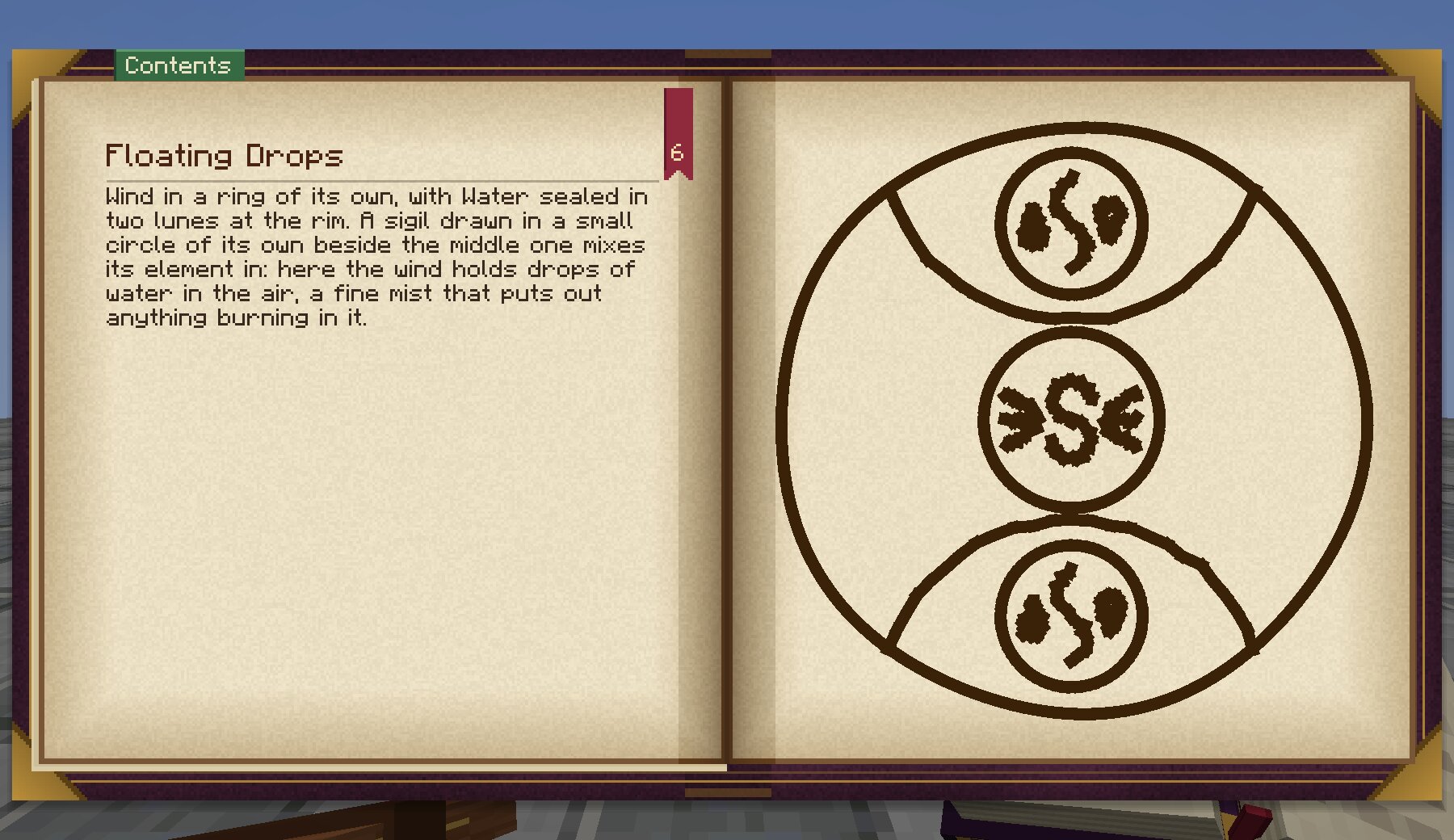
Some pairs make spells of their own:
| Middle | Sides | Spell |
|---|---|---|
| Wind (or Airy Forms) | Water | Floating Drops: drops of water hang in the air round the ring. They put out burning creatures and fires and moisten farmland |
| Water | Fire | Rainflinger: rain and standing water are kept out of its reach |
| Anything but Light | Light | Beast Repellent: animals and hostile creatures are driven out of its reach. Tamed animals are left alone |
Chains and triggers
Glyphs joined by a line of ink, drawn from the rim of one ring to the rim of another, are one chain. When one wakes, the rest wake with it, even those whose own rings were left open, and each glyph in the chain makes all the others stronger: many small linked glyphs beat one big one. The Raincleaver's blade is covered in them.
- No Tread in the chain. It lights in a wave along the lines, glyph after glyph, about a third of a second apart.
- A glyph with a Tread sign is a trigger. It works only while it is pressed: something standing on it (not its maker), or the block it is drawn on powered by redstone (a lever, button, pressure plate or redstone block next to it). Let go, and about two seconds later it waits again.
- A Tread closed while someone stands in it remembers them: from then on only they can press it.
- A Tread turned inward works the other way round: awake while nobody stands on it, quiet while it is pressed.
- The rest of a chain with a trigger waits for it: when the trigger is pressed they light in order along the lines, and when it is released they go back to waiting.
So chains make switches: a door of stone that opens on a lever, a trap under a plate, lights that come on when someone walks in.
Glyph arrows and dispensers
A glyph does not have to be drawn where it is cast.
- Glyph Arrow. Craft an arrow with a sheet of paper or a torn page that has a glyph on it. Shot from a bow, crossbow or dispenser, it casts the glyph where it strikes: on the face of the block it hits, or on the ground under the creature it hits. The strike closes a ring left open.
- Dispenser. Give a dispenser paper or a torn page with a glyph on it, and when it fires it casts the glyph from its own front and the page burns away. A blank page it throws out like anything else.
With no ink on the spot to keep it going, a spell cast this way lasts ten seconds at most.
Windowways
Draw the Window sign alone in a ring on a wall, floor or door, then another somewhere else: they join, and you can step into one and out of the other. A new window joins the last of yours still waiting. Joined windows share a rim colour; a waiting one stays dark grey. Make the ring at least two and a half blocks across, or you will not fit. Through a joined window you see the other side, with Sodium, Iris and shader packs too.
Sylph shoes
Draw Wind Underfoot on the soles of any boots: hold the boots in one hand and the pen in the other, and the glyph shows faintly to be traced, split across both soles. While you wear them, click your heels (jump twice) to fly as in creative: jump to rise, sneak to sink. Click them again, or touch the ground, to land. Nothing flies under water, and water washes the glyph off unless its ink is waterproof.
Ships
With Create Aeronautics (through Sable) installed, ships feel magic like everything else. A levitation glyph under a ship lifts it off the ground and holds it up; reversed, it lets the ship sink gently. Wind spells push it.
Draw the flight glyph on a ship's underside and stand on its deck, and the ship goes where you look. Crouch and it hangs still in the air.
Contraptions
A glyph drawn onto a thing makes the thing do magic by itself: the only way people who are not witches can use magic at all. Some hold their seal for good; most wear out and need a witch to restore them with pen and ink. See Artifacts.